Writing
I have published monographs, edited volumes, special journal issues, journal articles, book chapters, translations, interviews, and bibliographies. My work has been translated into French, Italian, Spanish, and Turkish. Select the buttons below to view my pages on Academia.edu and Google Scholar.
Below is a selection of monographs, edited and translated books, and special journal issues, followed by a list of other publications.
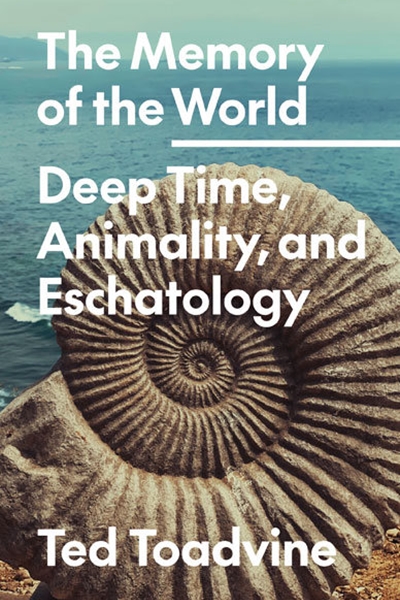
The Memory of the World: Deep Time, Animality, and Eschatology
By Ted Toadvine. University of Minnesota Press, 2024.
The Memory of the World argues for a new philosophy of time that takes seriously the multiple, pleated, and entangled temporal events spanning cosmic, geological, evolutionary, and human durations.
Critical Phenomenology after Merleau-Ponty (Part II)
Edited by Corinne Lajoie and Ted Toadvine. Special Section of Chiasmi International 24 (2022)
The second part in a series exploring Merleau-Ponty’s relationship with the emerging discourse of “critical phenomenology,” which draws on the methods and traditions of phenomenology to address contemporary ethical and political situations.

Critical Phenomenology After Merleau-Ponty
Edited by Ted Toadvine. Chiasmi International 23 (2021)
In honor of the 60th anniversary of Merleau-Ponty’s death, this volume offers a poignant look back at Merleau-Ponty as memorialized by friends and colleagues just after his death, alongside explorations of Merleau-Ponty’s significance for the future through the lens of the emerging discourses of critical phenomenology.
Encyclopedia of Phenomenology
Edited by Ted Toadvine and Nicolas de Warren. Springer, 2020.
The Encyclopedia of Phenomenology presents a comprehensive mapping of phenomenological thought on a global scale within philosophy and related disciplines. This reference work is the source in phenomenology for readers looking to verify terms, figures, and themes as well as to build upon for further publications.
Merleau-Ponty 1908/2008: Rare or Unpublished Dialogues and Texts
English translations edited by Ted Toadvine and Galen Johnson. Chiasmi International 20 (2018)
A trilingual collection of rare and unpublished texts in celebration of Merleau-Ponty’s 110th birthday.
Thinking the Outside: Politics, Aesthetics, Ontology
Edited by Ted Toadvine. Chiasmi International 19 (2018)
To think the outside. Even if this abstract formula verges on cliché, it nevertheless gives voice to a desire that echoes down many paths of thinking in Merleau-Ponty’s wake. What relation or encounter, if any, is possible between thinking and its beyond, between philosophy and what cannot be assimilated into history, sense, language, power, subjectivity, metaphysics, corporeality, life?
Existence, Diacritics, Animality
Edited by Ted Toadvine. Chiasmi International 15 (2013)
This volume of Chiasmi focuses on several major themes emerging within contemporary scholarship to which Merleau-Ponty’s thought makes a decisive contribution. At stake in each case is the future and limits of phenomenology, the ways that its approach must be radicalized or reformulated to account for our embodied existence, the diacritical structures of perception and reality, and our own animality and its relation to non-human life.
Continental Philosophy: What and Where Will It Be?
Edited by Ted Toadvine. Southern Journal of Philosophy 50, no. 2 (2012)
Is there today, and should there be tomorrow, such a thing as “Continental Philosophy”? We have posed this question as our theme for the special fiftieth anniversary issue. Our contributors, from nine countries on five continents, were asked to assess the future mode of “continental” thinking and the place for such a thinking—a thinking and a place “to come.”

Merleau-Ponty’s Philosophy of Nature
By Ted Toadvine. Northwestern University Press, 2009.
An “environmental crisis,” existing as it does in the human world of value and significance, is at heart a philosophical crisis. In this book, Toadvine demonstrates how Maurice Merleau-Ponty’s phenomenology has a special power to address such a crisis—a philosophical power far better suited to the questions than other modern approaches, with their over-reliance on assumptions drawn from the natural sciences.
The Merleau-Ponty Reader
Edited by Ted Toadvine and Leonard Lawlor. Northwestern University Press, 2007.
The first reader to offer a comprehensive view of Merleau-Ponty’s work, this selection collects in one volume the foundational essays necessary for understanding the core of this critical twentieth-century philosopher’s thought. The editors, who provide an interpretive introduction, also include previously unpublished working notes found in Merleau-Ponty’s papers after his death.

Nature’s Edge: Boundary Explorations in Ecological Theory and Practice
Edited by Charles S. Brown and Ted Toadvine. SUNY Press, 2007.
Nature’s Edge brings together leading environmental thinkers from the natural sciences, geography, political science, religion, and philosophy to explore the complex facets of boundary formation and negotiation at the heart of our environmental problems.
Merleau-Ponty: Critical Assessments of Leading Philosophers
Edited by Ted Toadvine. Four volumes. Routledge, 2007.
Gathers together the best critical writing on Merleau-Ponty’s work, including early reviews, the reactions of his contemporaries, key themes from his work on ontology, expression and politics, and the application of his thinking to such areas as feminist theory, psychology and child development, environmental philosophy and cognitive science.
The Being of the Phenomenon: Merleau-Ponty’s Ontology
By Renaud Barbaras. Translated by Ted Toadvine and Leonard Lawlor. Indiana University Press, 2004.
Renaud Barbaras’s De l’être du phénomène: l’ontologie de Merleau-Ponty, published in 1991, is considered one of the most powerful and complete elaborations of Maurice Merleau-Ponty’s thought.
Eco-Phenomenology: Back to the Earth Itself
Edited by Charles S. Brown and Ted Toadvine. SUNY Press, 2003.
This groundbreaking collection explores the intersection of phenomenology with environmental philosophy. Calling for a reexamination of beliefs central to the Western philosophical tradition, this book shifts previously marginalized environmental concerns to the forefront and calls for a new collaboration between phenomenologists and ecologically-minded theorists.

Merleau-Ponty’s Reading of Husserl
Edited by Ted Toadvine and Lester Embree. Springer, 2002.
Merleau-Ponty’s Reading of Husserl explores the relationship between Edmund Husserl, the father of modern phenomenology, and Maurice Merleau-Ponty, considered by many to be his greatest philosophical heir. This volume is the devoted to a comparison of the work of these two philosophers, with implications for our understanding of phenomenology’s significance, its method, and the future of philosophy.
Journal Articles (*refereed)
- * Anthropocene Time and the Memory of the World. Chiasmi International 24 (2022): 171–190.
- * Climate Collapse, Judgment Day, and the Temporal Sublime. Puncta: Journal of Critical Phenomenology 4 (2021): 127–143.
- Arzun Önceliği ve Ekolojik Sonuçları.[Turkish translation of “The Primacy of Desire and its Ecological Consequences.”] Cogito (Istanbul) 93 (2019): 113–127.
- * The End of All Things: Geomateriality and Deep Time. Investigaciones Fenomenológicas, Monográfico 7 (2018): 367-390.
- * Our Monstrous Futures: Global Sustainability and Eco-Eschatology. Symposium: Canadian Journal of Continental Philosophy 21, no. 1 (2017): 219–230.
- Biodiversità e diacritica della vita. [Italian translation of “Biodiversity and the Diacritics of Life.”] Animal Studies: Rivista italiana di antispecismo 6, no. 19 (2017): 37–54.
- * Musica Universalis ve Doğanın Hafızası [Musica Universalis and the Memory of Nature]. Cogito (Istanbul) 88 (2017): 193–214.
- * Nicolae Morar, Ted Toadvine, and Brendan Bohannan. Biodiversity at Twenty-Five: Revolution or Red Herring? Ethics, Policy & Environment 18, no. 1 (2015): 16–29.
- * The Time of Animal Voices. Konturen 7 (2014): 16–34. Reprinted in Environmental Philosophy 11, no. 1 (2014): 109-124.
- * The Elemental Past. Research in Phenomenology 44, no 2 (2014): 262–279.
- Tempo naturale e natura immemoriale. [Italian translation of “Natural Time and Immemorial Nature.”] Translated by Roberto Brigati. Discipline Filosofiche 24, no. 2 (2014): 9–22.
- * Nature’s Wandering Hands: Painting at the End of the World. Klēsis: Revue Philosophique 25 (2013): 109–123.
- Le temps des voix animales. [French translation of “The Time of Animal Voices.”] Chiasmi International 15 (2013): 269–282.
- Six Myths of Interdisciplinarity. Thinking Nature: A Journal on the Concept of Nature 1 (2011).
- * The Entomological Difference: On the Intuitions of Hymenoptera. Poligrafi: Journal for InterdisciplinaryStudy of Religion 16, no. 61–62 (2011): 185–214.
- “Parentesco Extraño”: Merleau-Ponty Sobre La Relación Humano-Animal. [Spanish translation of “‘Strange Kinship’: Merleau-Ponty on the Human-Animal Relation.”] Translated by Ana Cristina Ramírez Barreto. Devenires. Revista De Filosofía Y Filosofía De La Cultura 12 (2011), no. 23: 83-104.
- * Life Beyond Biologism. Research in Phenomenology 40, no. 2 (2010): 243–266.
- * Truth and Resistance. Graduate Faculty Philosophy Journal 30, no. 1 (2009): 111–124.
- * Natural Time and Immemorial Nature. Selected Studies in Phenomenology and Existentialism, vol. 34, edited by Peg Birmingham and Leonard Lawlor. Supplement to Philosophy Today 53 (2009): 214–21.
- Music, Being, Nature. Corps et Signes. No centenário do Nascimento de Claude Lévi-Strauss e Maurice Merleau-Ponty. Edited by Jean-Yves Mercury and Nuno Nabais. Colecção Documenta (Lisbon) 5 (2009): 167–177.
- * La resistencia de la verdad en Merleau-Ponty [The Resistance of Truth in Merleau-Ponty]. Investigaciones Fenomenológicas, Special Issue: Merleau-Ponty Desde la Fenomenología en su Primer Centenario, 1908-2008 (2008): 237–53.
- * The Reconversion of Silence and Speech. Tijdschrift voor Filosofie 70 (2008): 457–77.
- * Le Passage du temps naturel [The Passage of Natural Time]. Alter: Revue de phénoménologie 16 (2008): 157–69.
- * ‘Strange Kinship’: Merleau-Ponty on the Human-Animal Relation. Analecta Husserliana 93 (2007): 17–32.
- * Gestalts and Refrains: On the Musical Structure of Nature. Environmental Philosophy 2, no. 2 (2005): 61–71.
- * The Melody of Life and the Motif of Philosophy. Chiasmi International: Trilingual Studies Concerning Merleau-Ponty’s Thought 7 (2005): 263–79.
- * Limits of the Flesh: The Role of Reflection in David Abram’s Ecophenomenology. Environmental Ethics 27, no. 2 (2005): 155–70.
- * Singing the World in a New Key: Merleau-Ponty and the Ontology of Sense. Janus Head 7, no. 2 (2004): 273–283.
- * Chiasm and Chiaroscuro: The Logic of the Epochē. Chiasmi International: Trilingual Studies Concerning Merleau-Ponty’s Thought 3 (2001): 225–241.
- * Phenomenological Method in Merleau-Ponty’s Critique of Gurwitsch. Husserl Studies 17, no. 3 (2001): 195–205.
- * Nature and Negation: Merleau-Ponty’s Reading of Bergson. Chiasmi International: Trilingual Studies Concerning Merleau-Ponty’s Thought 2 (2000): 107–118.
- * The Cogito in Merleau-Ponty’s Theory of Intersubjectivity. Journal of the British Society for Phenomenology 31 (2000): 197–202.
- * Naturalizing Phenomenology. Selected Studies in Phenomenology and Existentialism, vol. 25, edited by Linda Alcoff and Walter Brogan. Supplement to Philosophy Today 44 (1999): 124–31.
- * The Art of Doubting: Merleau-Ponty and Cézanne. Philosophy Today 41 (1997): 545–53.
- * Absolution of Finitude in Hegel’s Phenomenology of Spirit. Southwest Philosophy Review 12 (1996): 141–56.
- * Hermeneutics and the Principle of Explicability. Auslegung 20 (1995): 59–75.
Book Chapters (*refereed)
- Sweet Potato Pie. That Necessary Supplement: Food Drink Think, edited by Ron Broglio, Cary Wolfe, and Adam Nocek, 230–234. Tempe, Arizona: Arizona State University, 2024.
- * Maurice Merleau-Ponty. Stanford Encyclopedia of Philosophy (revised 2023; original version, 2016), http://plato.stanford.edu/entries/merleau-ponty/
- * Ecophenomenology after the End of Nature. In Transforming Politics with Merleau-Ponty: Thinking Beyond the State, edited by Jerome Melançon, 127–144. Lanham, MD: Rowman and Littlefield, 2021.
- Limits of the Flesh: The Role of Reflection in David Abram’s Ecophenomenology. In Literature and the Environment: Critical and Primary Sources, edited by Stephanie LeMenager and Teresa Shewry, 123–136. London: Bloomsbury, 2021. Reprinted from Environmental Ethics.
- * Climate Apocalypticism and the Temporal Sublime. In Environmental Ethics: Cross-Cultural Explorations, edited by Monika Kirloskar-Steinbach and Mădălina Diaconu, 115–131. Freiburg: Verlag Karl Alber, 2020.
- * Geomaterialities. In 50 Concepts for a Critical Phenomenology, edited by Gail Weiss, Ann Murphy, and Gayle Salamon, 149–154. Evanston: Northwestern University Press, 2019.
- * Thinking After the World: Deconstruction and Last Things. In Eco-Deconstruction: Derrida and Environmental Ethics, edited by Matthias Fritsch, Philippe Lynes, and David Wood, 21–47. Bronx: Fordham University Press, 2018.
- * Naturalism, Estrangement, and Resistance: On the Lived Senses of Nature. In Ontologies of Nature: Continental Perspectives and Environmental Reorientations, edited by Gerard Kuperus and Marjolein Oele, 181–198. Berlin: Springer, 2017.
- * Phenomenology and Environmental Ethics. In Oxford Handbook of Environmental Ethics, edited by Stephen Gardiner and Allen Thompson, 174–185. Oxford: Oxford University Press, 2016.
- * Biodiversity and the Diacritics of Life. In Carnal Hermeneutics, edited by Brian Treanor and Richard Kearney, 235–248. Bronx: Fordham University Press, 2015.
- * Apocalyptic Imagination and the Silence of the Elements. In Ecopsychology, Phenomenology, and the Environment: The Experience of Nature, edited by Douglas A. Vakoch and Fernando Castrillón, 211–221. Berlin: Springer, 2014.
- * Maurice Merleau-Ponty and Lifeworldly Naturalism. In Husserl’s Ideen, edited by Lester Embree and Tom Nenon, 365–380. Berlin: Springer, 2013.
- * Enjoyment and its Discontents: On Separation from Nature in Levinas. In Facing Nature: Levinas and Environmental Thought, edited by William Edelglass, James Hatley, and Christian Diehm, 161–189. Pittsburgh: Duquesne University Press, 2012.
- * The Chiasm. In Routledge Companion to Phenomenology, edited by Sebastian Luft and Sören Overgaard, 336–47. London: Routledge, 2011.
- * Ecological Aesthetics. In Handbook of Phenomenological Aesthetics, edited by Lester Embree and Hans Reiner Sepp, 85–91. Berlin: Springer, 2010.
- * Ecophenomenology and the Resistance of Nature. In Advancing Phenomenology: Essays in Honor of Lester Embree, edited by Philip Blosser and Thomas Nenon, 343–55. Berlin: Springer, 2010. Reprinted in Environment, Embodiment and Gender: An Anthology on Man, Nature and the concepts of Nature, edited by Ane F. Aarø and Johannes Servan, 49–65. Bergen: Hermes Text, 2011.
- * Phenomenology and ‘Hyper-Reflection’. In Merleau-Ponty: Key Concepts, edited by Rosalyn Diprose and Jack Reynolds, 17–29. Stocksfield, UK: Acumen Publishing, 2008.
- * How Not to Be a Jellyfish: Human Exceptionalism and the Ontology of Reflection. In Phenomenology and the Non-Human Animal: At the Limits of Experience, edited by Christian Lotz and Corinne Painter, 39–55. Berlin: Springer, 2007.
- * Culture and Cultivation: Prolegomena to a Philosophy of Agriculture. In Nature’s Edge: Boundary Explorations in Ecological Theory and Practice, edited by Charles S. Brown and Ted Toadvine, 207–22. Albany: SUNY Press, 2007.
- * Limits of the Flesh: The Role of Reflection in David Abram’s Eco-Phenomenology. In Interrogating Ethics: Embodying the Good in Merleau-Ponty, edited by James Hatley, Janice McLane, and Christian Diehm, 249–64. Pittsburgh: Duquesne University Press, 2006. Reprinted from Environmental Ethics.
- Naturalizing Phenomenology. InEnvironmental Philosophy: From Animal Rights to Radical Ecology, 4th ed., ed. Michael Zimmerman et al., 326–34. Upper Saddle River, NJ: Prentice Hall, 2005. Reprinted from Philosophy Today.
- * Sense and Non-Sense of the Event in Merleau-Ponty. In Ereignis auf Französisch: Von Bergson bis Deleuze, edited by Marc Rölli, 121–34. Munich: Wilhelm Fink, 2004.
- * The Primacy of Desire and its Ecological Consequences. In Eco-Phenomenology: Back to the Earth Itself, edited by Charles Brown and Ted Toadvine, 139–53. Albany: SUNY, 2003.
- * Leaving Husserl’s Cave? The Philosopher’s Shadow Revisited. In Merleau-Ponty’s Reading of Husserl, edited by Ted Toadvine and Lester Embree, 71–94. Dordrecht: Kluwer Academic Publishers, 2002.
- * Merleau-Ponty’s Reading of Husserl—A Chronological Overview. Appendix to Merleau-Ponty’s Reading of Husserl, edited by Ted Toadvine and Lester Embree, 227–86. Dordrecht: Kluwer Academic Publishers, 2002.
- Ecophenomenology in the New Millennium. In The Reach of Reflection: Issues in Phenomenology’s Second Century, edited by Steven Crowell, Lester Embree, and Samuel J. Julian. Center for Advanced Research in Phenomenology, Inc, 2001.
Essay Translations
- Translation of Maurice Merleau-Ponty, Excerpt from the discussion following A. de Waelhens’s «Commentaire sur l’Idée de la phénoménologie ». Merleau-Ponty 1908/2018: Rare or Unpublished Dialogues and Texts. Chiasmi International: Trilingual Studies Concerning Merleau-Ponty’s Thought 20 (2018): 241–43.
- Translation of Mathias Goy, Merleau-Ponty: The Legacy of his Oeuvre.Merleau-Ponty 1908/2018: Rare or Unpublished Dialogues and Texts. Chiasmi International: Trilingual Studies Concerning Merleau-Ponty’s Thought 20 (2018): 43–59.
- Translation of Maurice Merleau-Ponty, Man and Adversity: Discussion. In The Merleau-Ponty Reader, edited by Ted Toadvine and Leonard Lawlor, 207–40. Evanston: Northwestern University Press, 2007.
- Translation (with Elizabeth Locey) of Maurice Merleau-Ponty, Reading Notes and Comments on Aron Gurwitsch’s The Field of Consciousness. Husserl Studies 17, no. 3 (2001): 173–93.
- Translation of Françoise Dastur, World, Flesh, Vision. In Chiasms: Merleau-Ponty’s Notion of Flesh, edited by Fred Evans and Leonard Lawlor, 23–49. Albany: SUNY Press, 2000.
Book Reviews
- Diacritics of the Inexpressible: Tracing Expression with Veronique Foti. Review essay of Veronique Foti, Tracing Expression in Merleau-Ponty: Aesthetics, Philosophy of Biology, and Ontology (Evanston: Northwestern University Press, 2013), in Chiasmi International 16 (2014): 301–306.
- Review of Simon James, The Presence of Nature: A Study in Phenomenology and Environmental Philosophy (New York: Palgrave McMillan, 2009), in Environmental Values 20, no. 2 (2011): 287–90.
- Review of Adrian Parr, Hijacking Sustainability (Cambridge: MIT Press, 2009), in Environmental Philosophy 7, no. 2 (2010): 178–82.
- Review of Douglas Low, Merleau-Ponty’s Last Vision (Evanston: Northwestern University Press, 2000) in Philosophy in Review 22, no. 1 (February, 2002): 59–61.
- Review of William McKenna and J. Claude Evans, eds., Derrida and Phenomenology (Dordrecht: Kluwer Academic Publishers, 1995) in Journal of the British Society for Phenomenology 30, no. 3 (1999).
- Review of Richard Holmes, The Transcendence of the World: Phenomenological Studies (Waterloo, Ontario: Wilfrid Laurier University Press, 1995) in Canadian Philosophical Reviews 15 (August, 1995): 31–32.
Interviews
- Qualche domanda a Ted Toadvine, intervista a cura di Prisca Amoroso. Emergenza Ecologica: Officine Filosofiche 3 (2016): 111–119.
- Eksperter fremmedgjør miljødebatten (interview with Kim E. Andreassen). På Høyden: Uavhengig Avis For Universitetet i Bergen (2008). http://pahoyden.no/2008/10/eksperter-fremmedgjor-miljodebatten
Bibliographies
- Merleau-Ponty Primary Source Bibliography, International Merleau-Ponty Circle, 2017. http://www.merleauponty.org/wp-content/uploads/2017/01/merleaupontyprimarybibliography-updated20171.pdf
- Simone de Beauvoir and Existential Phenomenology: A Bibliography. In The Existential Phenomenology of Simone de Beauvoir, edited by Wendy O’Brien and Lester Embree, 205–251. Dordrecht: Kluwer Academic Publishers, 2001.
 Ted Toadvine, Ph.D.